Tuesday, October 9, 2012

Colt LE6920 Magpul Edition With Anodized Receiver Review


Well, first and foremost the LE6920 Anodized Magpul edition (Model: LE6920MPFDE) lives up to the standards Colt is known for.

The big question when it comes to Colt ARs in my opinion is––-are they worth the money they charge over lower priced competitors like PSA, Spikes, Windam, ect... Tough to say as it's an individual decision. I generally only recommend Colt ARs to people who don't know anything about ARs and have a ~1k budget because you really can't go wrong with one. But, I'm certainly not a Colt fan-boy as this is the only Colt rifle I personally own and I have nothing but good things to say about my other PSA ARs. I only bought this one because I got a good deal on it and I sold another rifle I bought years ago and made $450 on it to put toward this AR (and because I like shiny FDE products!).

Pros(and features):
-1 in 7 chrome lined 16.1'' barrel with A2 style brake
-5.56 chamber
-MPI (or MPC as Colt calls it) inspected bolt
-Anodized upper, lower, and buffer tube
-Magpul stock, rear sight, pistol grip, mags (2x black PMags), handguard, and VFG included
-Cleaning kit and sling included
-Good out of the box mil spec trigger (pulls crisp between 6-7lbs)
-This model has LE serial number (some people think this is a big deal, not me however)
-Reliability (0 failures of any kind through 500 rounds, the vast majority Barnaul ammo)

Cons:
-Cost
-Stepped M4 barrel isn't used/needed by the vast majority of shooters
-The anodization seems to turn color or hold carbon on the inside of the upper even after being cleaned(the video shows it better than I can write it)

Bottom line: You really can't go wrong with the 6920. If you're looking for a quality, reliable, out of the box AR at around $1k this rifle deserves consideration. You can probably get a similar quality rifle for less, especially if you build it, but you'd probably be increasing your chances of getting a lemon.

Here's a video with some discussion, shooting from 15m, 40m, and 75m (the farthest line of sight I have on the land). I also do a quick table top discussion and chrono some Hornday TAP 75gr and Silver Bear 62gr HP rounds.

Chrono Data:
Hornady 223 75gr TAP: 2437fps, 989ft/lbs energy
Silver Bear 62gr HP: 2687fps, 994ft/lbs energy

Monday, October 8, 2012

Springfield Armory TRP 1911 Review


Most of you already know the back story but if not---the Springfield Armory PRO model was chosen by the FBI's HRT unit years ago and Springfield Armory realized there would soon be a demand for a civilian weapon built around the same specs as required by the FBI.   The PRO is a custom 1911, with all the features, especially the price, that you'd expect from a custom 1911.  The TRP comes extremely close to the PRO model in terms of feel/performance but at a much lower price point.  I waited on a backorder list for a long time to get this gun after shooting one a couple years ago and the wait was worth it.   This gun has been a stellar performer since day 1.   Here's a quick summary:

Pros:
-100% reliable through over approximately 2k rounds
-Low profile adjustable night sights
-Match grade bull barrel
-Forged steel frame/slide
-G10 grips that give a great purchase
-20 LPI front strap checkering
-Excellent slide to frame fit
-Armory Kote finish seems very durable thus far
-Standard rail for mounting lights/accessories
-Weight-45oz helps absorb recoil
-Wide mouth mag well for quick reloads
-Cost (expensive, but a great value in my opinion)
-Great accuracy
-Crisp trigger that breaks cleanly around 4-4.5lbs
-Comes with a great hard case from the factory with 2 mags, holster, and mag holster

Cons:
-Needs tools for disassembly
-Adjustable rear sight (not a con for me, but it is for many)
-Cost (not as expensive as some 1911s, but more than most production guns)
-Availability: most people have to get on a backorder list to acquire one

Here's a video I made showing some shooting, an 'accuracy test' (the gun is much more accurate than me or the Aguila ammo I was using), disassembly/assembly of the pistol, a table top style overview, and some chronograph testing with popular defensive loads.


Bottom line: if you're looking for a 1911 for HD, the TRP is tough to beat at its' price point.  It's simply a superb 1911.  There may be 'better' 1911s, but not in this price range in my opinion.


Chronograph Data:

Hornady Critical Defense 185gr: 1113fps, 509ft/lbs energy
Winchester Ranger 230gr JHP: 938fps, 449ft/lbs energy
Federal HST 230gr JHP: 872fps, 388ft/lbs energy
Federal HST +p 230gr JHP: 945fps, 456ft/lbs energy

Saturday, October 6, 2012

Ultimak Rail & Bushnell TRS 25 Red Dot Review


For those out there who have trouble using the stock AK sights or want a red dot optic for quicker target acquisition but don't want to pay $600 for an Aimpoint T1 this set up may be what you're looking for.   I've had this set up on several of my AKs and never had an issue at all with it to report.

Pros:
-Cost.  The entire set-up can be had for around $170 shipped if you pay attention to the sales
-The rail is made out of T6 aluminum and the clamps are 4140 steel
-Installation is very simple and with polymer AK handguards no modification is necessary to the lower handguard.  If you're using wood handguards, the lower may need some fitting
-The rail as plenty of room to mount a light should you have the desire to do so
-Maintains zero
-I haven't seen any change in accuracy with the Ultimak as I have while using the Midwest Industries rail system (but, there's pros and cons to both... and I like both)
-The TRS25 has a 3MOA dot which is about all the accuracy most shooters will get out of their AKs anyway
-The light emitter on the TRS allows for a lower 1/3 co-witness so even if your optic batter died an an inopportune time you still have use of the irons
-I have seen no evidence at all of heat damage.  I don't have the happy switch on any of my AKs but I've also never thought to shoot slowly due to heat.  


Cons:
-With all forward AK rail mount options, it does cause the rifle to be slightly front heavy
-The tube gets hot and you may need to watch your grip during rapid fire (see the video for clarification on this...)
-If you're comparing it to an Aimpoint, the dot isn't as clear but I don't expect it to be at this price point either

Here's a video review with a demonstration of some shooting from CQB distances, 60m, and a discussion of the pros and cons of the system:


Friday, October 5, 2012

Palmetto State Armory 10.5'' AR Upper Review


Well, after over 6 months of waiting, I've gotten to run my 10.5'' PSA upper on a real AR lower to see how it runs. I had been running it for a bit using a pistol lower but we all know that's no where near as much fun!

So far, I've got nothing but good things to say about this upper. It's run great, been accurate, reliable, ect... Running it with the Troy Claymore seems to really help negate the concussion typically found on SBRs, although that's probably not the case for anyone downrange from the shooter but who cares about them?!

Here's a quick synopsis of the upper, barrel, and BCG (the heart and soul of the AR if you will....).

Pros/features:

-Hammer Forged Chrome Moly Vanadium barrel
-Extra-thick Chrome-lined bore (whatever that means....)
-5.56 NATO Chamber
-1 in 7" twist rate
-Forged upper
-Heavy profile BCG (more on this below)
-Milspec Carpenter No. 158® steel bolt
-Shot Peened Bolt
-Chrome Lined Carrier
-Chrome Lined Gas Key
-Gas Key Hardened to USGI Specifications
-Gas Key Grade 8 Hardened Fasteners
-Gas Key Staked Per Mil-Spec
-Tool Steel Extractor
-Extractor Spring
-Black Extractor Insert
-Cost ($369 withouth BCG, currently. $329 when I bought it)
-It balances very well, even with the YHM Diamond Series Rail
-0 malfunctions thus far

Cons:

-It's not free, unfortunately....
-Having to wait for your stamp to come back in order to run it on a rifle lower (not a product per se of theupper, just all sub 16'' OAL uppers in general)
-Velocity loss from a shorter barrel

I really like this upper and may actually get another for the next SBR project I'm thinking of building. Here's a video (above) of me running it a bit, shooting at some steel, a quick tabletop review, and some chronograph testing:

Chronograph Data:
Hornady 223 75gr TAP: 2157fps, 775ft/lbs energy
Silver Bear 62gr HP: 2403fps, 795ft/lbs energy

Smith and Wesson Shield 9mm Review


The Shield is one of the, if not the, most talked about handguns within the shooting community this year.   The trend for small carry guns in 380 seems to have been set aside for compact single stack 9mm guns.   The Shield certainly isn't the smallest of the "pocket 9s" but it may well be the best.  I've shot the Nano, Solo, PF9, PM9, P938, and own the CM9...  if I had to pick one of them it'd be the Shield.    Here are some reasons why:

Pros:
-Reliable.  I just passed the 1K round mark with this gun using everything from steel cased Russian ammo to quality JHPs it's never missed a beat
-Shootable.   Of the guns I mentioned above, the Shield is the easiest to shoot well.   Many of these small guns tend to jump around in your hand causing the shooter to re-grip halfway through the magazine; the Shield doesn't seem to have that problem
-Lightweight.  It comes in at 19oz unloaded
-Great finish.  The melonite (68 HRc) finish is top notch.   With over 1K through the gun it shows less signs of wear than my SIG P229 did after 200 rounds
-It comes with usable sights.  I replaced my sights with Trijicon NS but the factory 3 dot sights are easy to use and better than most guns in its' class.
-Cost.  I got mine for $389 OTD right when they were released and used the Nation's Finest rebate (they used to honor it for the Shield but no longer do.  They now have MIL/LE pricing however) for an additional $50 off.  
-Value.  For the cost above you get a well built, seeming very durable firearm that carries extremely well.  Due to this, demand is currently exceeding supply and they're hard to find.
-Lots of aftermarket support from Apex parts to night sights to holsters.
-Comes with two mags (some of the competitors don't); a 7 round flush fit and 8 round extended mag.
-It has by far the best out of the box trigger of any gun in the M&P lineup; the reset isn't faint like the rest of the series.  My trigger breaks consistently at 6lbs.
-You don't have to pull the trigger for disassembly.  That's important to some people so I mentioned it to me but I don't mind pulling the trigger (as you'll see in the video below).
-Fish scale serrations allow for a positive purchase on the slide when manipulating the weapon.

Cons:
-Right side only controls.  If you're a lefty you likely won't appreciate that.\
-External safety.  I'm in the camp of the people who do not like external safeties on a striker fired gun.   That said, it takes an intentional sweep to put it in the 'on' position and I worry little about it accidently coming on (has never happened yet).  Also, for those who like external safeties it's still a con.   Reason being it's small and difficult to manipulate...  likely more so under stress.   I think they tried to compromise here and missed both ways.
-It's larger than some of its' competitors.  I don't find it to be a pocket gun (I know some do) unless I'm wearing cargo pants/shorts.


Here's a video with some shooting from the 12m line, a size comparison with a couple carry guns, demonstration of disassembly and assembly of the gun, a quick discussion of the guns' pros and cons, and some chronograph testing with some popular defensive rounds


Chrono numbers:

Hornady 147gr TAPs: 894 fps, 261 ft/lbs energy
Federal 124gr HSTs: 1016 fps, 284 ft/lbs energy
Speer 124gr Gold Dots: 1076 fps, 319 ft/lbs energy


Thursday, October 4, 2012

SIG P229R Review


The SIG P229 was the first gun to be made exclusively in New Hampshire rather than Germany. US vs German made SIGs are a controversial subject in the SIG community but I don't care where the gun was made as long as it performs as I expect it to; and this gun does.

I currently have about 600 rounds this gun and below are a few of the pros and cons that I've found.

Pros:
-Reliable. This gun has never had a malfunction of any kind with any ammo I've fed it
-Accurate. The gun is easy to shoot well; especially in SA mode
-Ergonomic. The gun, with E2 grips, just feels great in the hand
-The Nitron finish on the slide is holding up well to holster wear
-Rail for attaching lights/accessories
-Aftermarket parts/holsters/support are widely available
-Standard DA trigger is smooth with little to no stacking
-SA trigger breaks crisply
-2x 15 round Mec-gar mags came with this gun

Cons:
-Cost. SIGs are generally overpriced relative to their competitors in my opinion
-Finish on the barrel is wearing more than I would expect for a gun of this quality
-The SA trigger has a good bit of take-up from the reset point (SRT greatly helps this however)

The video below shows some shooting from the 12m line, rapid fire from the 10m line with a shot timer to demonstrate the controllability of the pistol, a tabletop review and size comparison with the G19, and chronograph testing with Winchester Rangers, Gold Dots, and Federal HSTs:


Chronograph numbers:
-Winchester Ranger 115gr JHPs: 1136fps, 329 ft/lbs energy
-Speer Gold Dot 124gr JHPs: 1189fps; 389 ft/lbs energy
-Federal HST 124gr +p JHPs: 1170fps; 377 ft/lbs energy

Monday, October 1, 2012

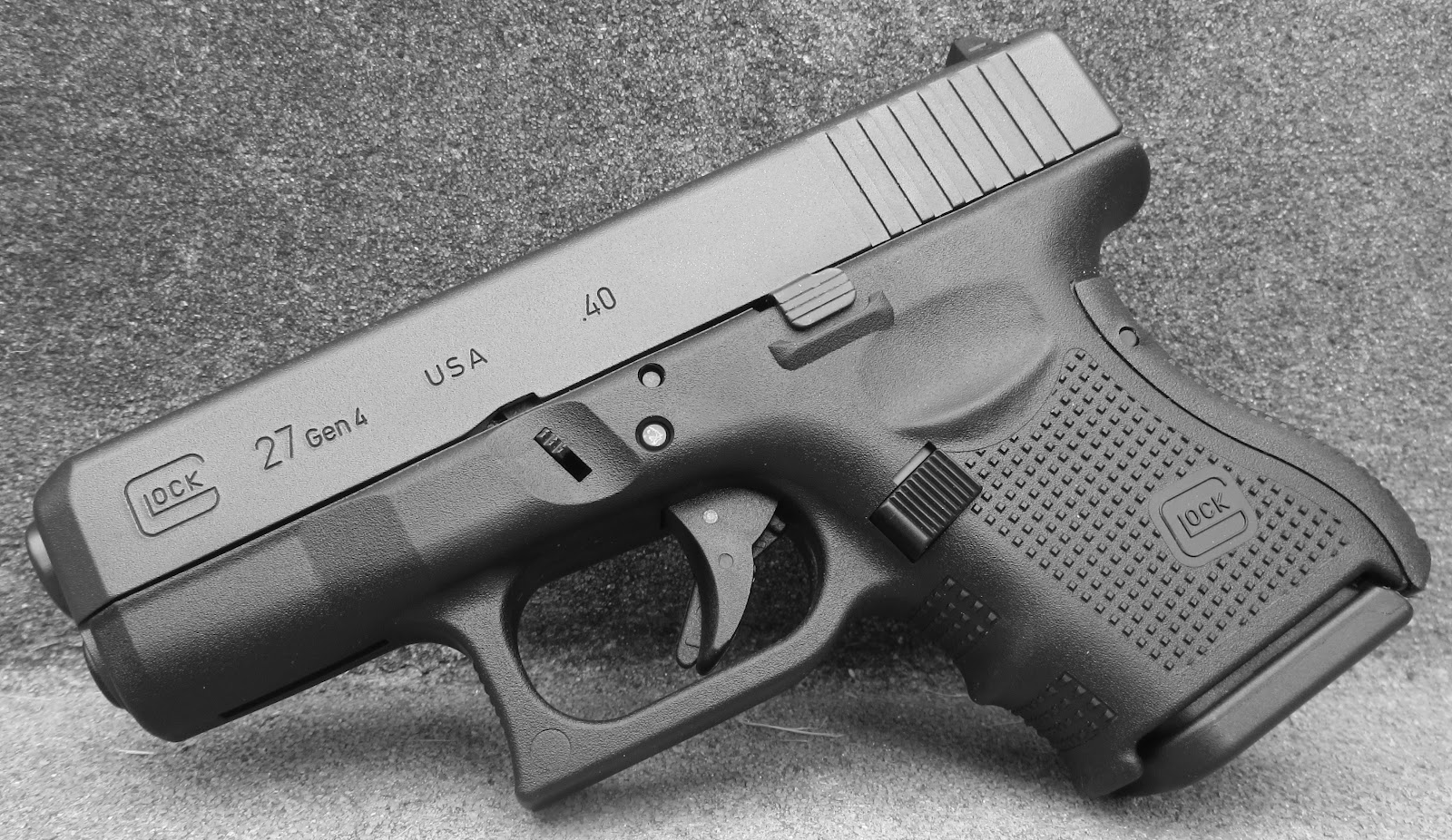
USA Made Gen4 Glock 27 Review


I went into my local blue label dealer and asked if they could get me a Gen4 G27 with a serial number that started with "AA" (the US made guns do currently) and surprisingly the next day he called me and said he had one for me to pick up.   Well giddy up!   

When I first inspected it the first thing I noticed was the proof markings (see photos below) with the GA state outline with a "P" in the middle indicating it has been proof tested at the Smyrna GA plant.  I've seen several other US made Glocks before but never saw this proof mark; I'm not sure if it'll be the standard going forward or if only a limited run got the marking; I suppose time will tell...

The second thing I noticed was that the gun had the serrated trigger which I believe has been added to the compact and subcompact Glocks due to import restrictions.  Since this gun doesn't have to be imported putting this trigger on it seems like a bad move to me; I don't know anyone that prefers the serrated trigger to the smooth one.   That said, it's a simple swap but still worth mentioning...

So far, the gun has been a typical G27---reliable and mild recoiling for its' size and weight.    I've only fed it 370 rounds to this point including weights from 135gr to 180gr, flat nose FMJs, standard FMJs, and JHPs from Speer, Federal, and Winchester all without a single hiccup.   Here's a quick summary of the pros and cons.  

Pros: 
-Reliable. 0 malfunctions so far (the round count is low but so far so good)
-Durable finish so far.   This will likely be of interest considering all the rumors of the use of the tennifer treatment in the US (I know they haven't used it in a while but people still talk about it so I'm just throwing it out there....)
-Easy to maintain 
-TONS of aftermarket parts, holsters, ect... available 
-Accepts 9, 13, 15, and 22 round factory magazines 
-The baby Glocks carry very well in an IWB rig
-Glock's customer service is second to none 
-Cheap replacement parts, should you ever need them 
-Low Bore Axis resulting in a relatively soft shooting gun, especially considering most people will only be able to get two fingers on it
-Easily modified to fit the shooters' preferences
-Requires very little cleaning/lubrication to run reliably
-I like the Gen4 grip texture; especially in the 40S&W guns.   It helps prevent the gun from jumping around in your hand if they're sweaty/wet
-It's had consistent and strong ejection with all ammo (see the video below)
-The multiple backstrap system allows you to choose which grip size you prefer
Cons: 
-I'm not a fan of the factory plastic sights
-That stupid serrated trigger
-It's not a beginners gun IMO.   New shooters that have fired my Gen3 G27 have had to regrip the gun frequently due to the combination of the grip and the relatively sharp 40S&W recoil impulse
-The short barrel will result in lower muzzle energy compared to its' bigger brothers (G23/22)

Here's a video with some shooting from the 12m line,  a table top review and discussion, some close up shots of the proof markings,  and a chronograph test with some popular defensive loads.


Chrono results:

Winchester Ranger 135gr JHPs: 1093fps, 358 ft/lbs energy
Federal HST 165gr JHPs: 973fps, 347 ft/lbs energy
Speer Gold Dot 180gr JHPs: 935fps, 343 ft/lbs energy